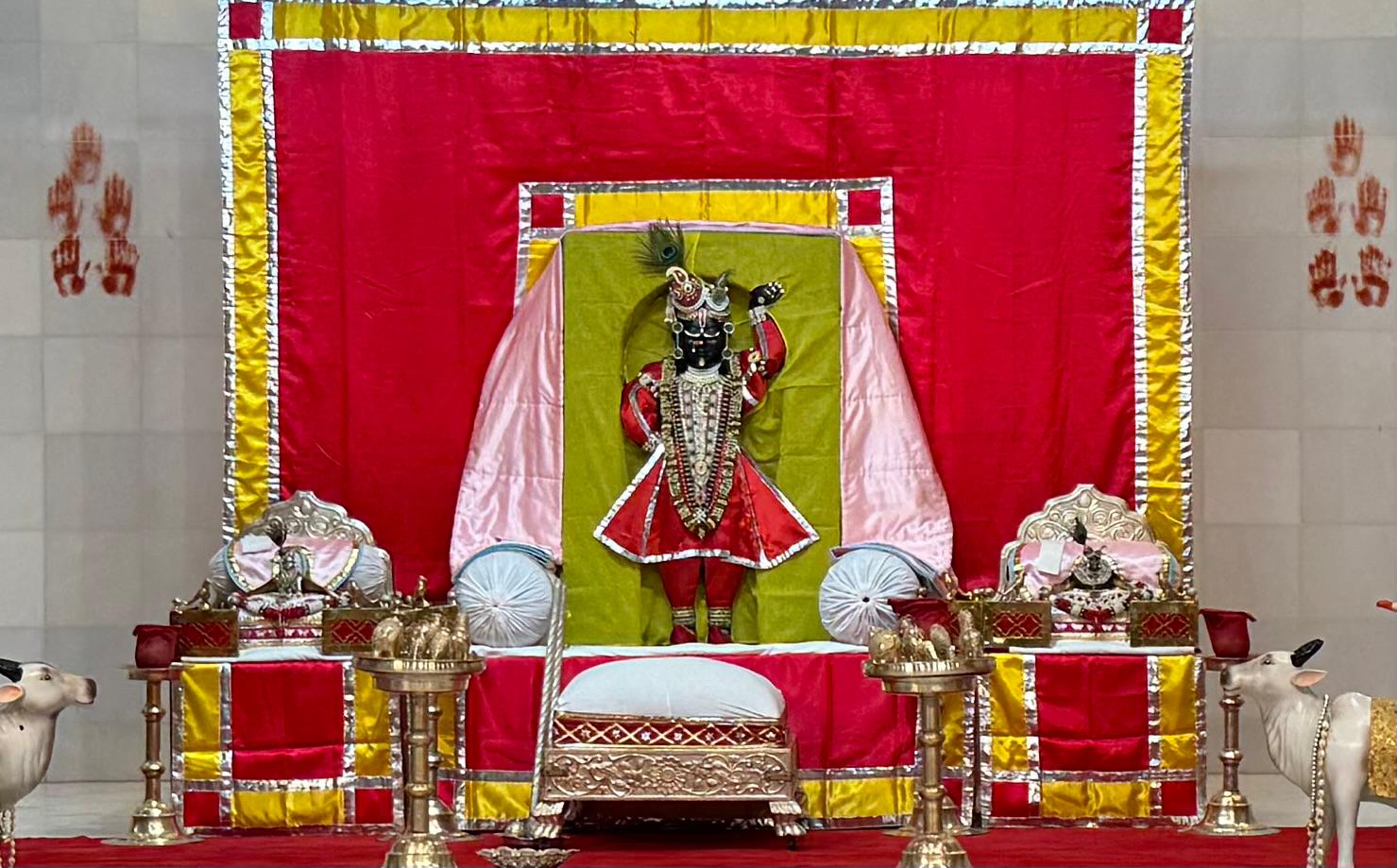
Shrinathji is Lord Krishna in the form of a seven-year-old child — the central deity of Pushtimarg and the Lord of this Haveli. His swaroop captures the eternal moment when the young Krishna lifted the sacred Govardhan Hill on the little finger of his left hand to shelter the people and cows of Vrindavan from the wrath of Indra. His left arm raised, his right hand resting at his waist, his eyes gazing downward with infinite compassion — this is Shrinathji.
The swaroop is self-manifested — it emerged from Govardhan Hill itself. Discovered in 1493 CE by the saint Madhavendra Puri, it was Shri Vallabhacharya who recognized this form as the living Krishna and established the daily seva of Pushtimarg. Originally called Devdaman, then Gopala by Vallabhacharya, the deity was finally named Shrinathji by his son Vitthal Nathji — who also gave form to the elaborate eight-darshan worship observed in every Haveli to this day.
In 1672 CE, to protect the sacred swaroop from destruction by Mughal emperor Aurangzeb, the deity was carried south through Rajasthan on a chariot. When the wheels sank axle-deep into the earth at the village of Sihad and could not be moved, the priests understood — Shrinathji had chosen his resting place. Under the protection of Maharana Raj Singh of Mewar, a Haveli was built there. That village was renamed Nathdwara — the Gateway to the Lord — and remains the principal seat of Pushtimarg to this day.
The idol is carved from a single piece of black marble. Every element of the swaroop is drawn from the divine pastimes of Krishna in Vraj — devotional, not merely decorative.
The raised left arm holds the Govardhan Hill — the defining gesture of Shrinathji, representing eternal protection and divine refuge for all who surrender to him.
The right hand rests in a relaxed fist at his waist — a posture of natural ease and divine authority that captures the playful confidence of the child Krishna.
His eyes gaze downward with infinite compassion. Beneath his lips rests a large diamond — a jewel of unparalleled love offered by his devotees, forever adorning the Lord's face.
Two cows are engraved at the base — the beloved cows of Vrindavan whom the young cowherd Krishna tended, central to his Bal Leela and to the spirit of Vraj.
A lion and a snake — the mightiest and most feared of creatures — appear at his feet, representing all of creation sheltered beneath his raised arm without distinction or fear.
Two peacocks and a parrot — the beloved birds of Vrindavan — surround the Lord alongside three sages, the eternal seers whose devotion first gave voice to his glory in scripture.
Shrinathji is cared for as a living child — woken, dressed, fed, and put to rest through eight sacred darshans each day. The Haveli opens only during these darshans; the Lord rests between them. Each carries its own bhava, its own shringar, its own offering of love.
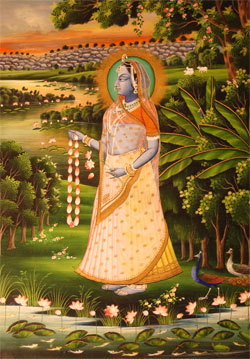
Shri Yamunaji Maharani
In Pushtimarg, Yamunaji is not merely a sacred river — she is the living embodiment of bhakti itself. She is Shrinathji's most beloved Swamini, as dark and deep as Krishna himself, flowing eternally wherever he dwells. It was through her grace that Vallabhacharya first received the Lord's darshan — when he rested on her shores at Thakurani Ghat in Gokul, Yamunaji appeared before him, and through her divine intercession, Shri Krishna himself came to Mahaprabhuji at midnight with the Brahmasambandha mantra.
In gratitude, Vallabhacharya composed the Yamunashtakam — the first of his sixteen works — a hymn of nine verses in her praise. Its opening verse, recited daily by Vaishnavs across the world, declares her the giver of all divine powers, whose banks are touched by the lotus feet of Shri Krishna, and through whose grace devotees become as dear to the Lord as the Gopijans of Vraj.
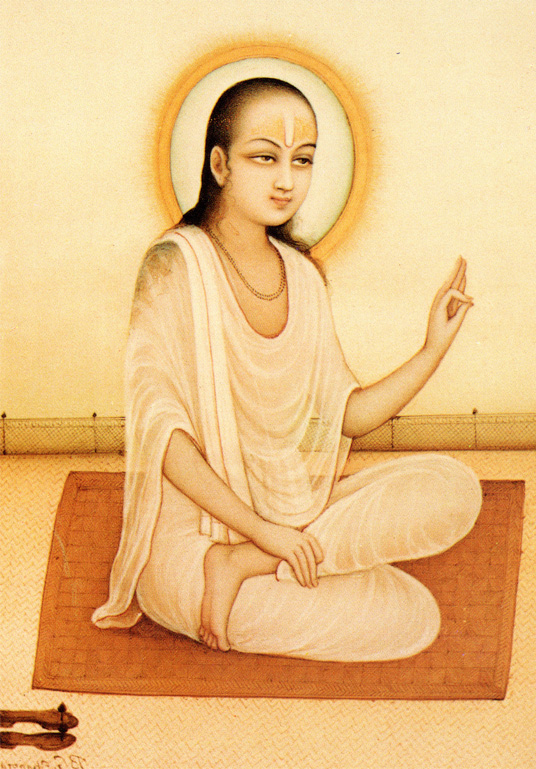
Shrimad Vallabhacharya
1479 — 1531 CE · Champaranya
Born in 1479 CE in Champaranya (present-day Chhattisgarh), Vallabhacharya mastered the Vedas, Puranas, and all major philosophical traditions before the age of sixteen. He won the great debate of Brahmavada at the court of Emperor Krishnadevaraya, earning the title Jagadguru, and undertook three barefoot Bharat Parikramas — pilgrimages across all of India — giving discourses on the Bhagavata Purana at 84 sacred locations known as the Chaurasi Baithaks, which remain living pilgrimage sites to this day. At 52, having fulfilled his mission, he entered the sacred Ganga at Kashi on the day of Rathayatra and was witnessed by many dissolving into a luminous divine light.
In 1494 CE, at Thakurani Ghat on the banks of the Yamuna in Gokul, Shri Krishna himself appeared before Vallabhacharya at midnight and bestowed upon him the Brahmasambandha mantra — the complete and total surrender of body, senses, breath, and mind at the Lord's lotus feet. This is the sacred initiation that binds every Vaishnav to Shrinathji and marks the formal entry into Pushtimarg. It is not a ritual of mere passage — it is the moment the soul consciously offers itself, in entirety, to the Lord.
The Brahmasambandha may only be bestowed by the direct male descendants of Vallabhacharya — the Vallabha Kula — and has passed unbroken from Acharya to devotee across five centuries. To receive it is to stand in the same lineage of grace that began when Krishna himself spoke to Mahaprabhuji on that midnight shore. It is the living root from which every Vaishnav's relationship with Shrinathji grows.
अनन्याश्चिन्तयन्तो मां ये जनाः पर्युपासते ।
तेषां नित्याभियुक्तानां योगक्षेमं वहाम्यहम् ॥
"Those who worship me with devotion, meditating on my transcendental form — to them who are constantly devoted, I carry what they lack and preserve what they have."
— Bhagavad Gita 9.22 · cited by Vallabhacharya in the Subodhini as the foundation of Pushti grace
Vallabhacharya's philosophy is called Shuddhadvaita — Pure Non-Dualism. It holds that Shri Krishna alone is the Supreme Brahman, and that the world, the individual soul, and God are all equally, genuinely real — not illusion, not shadow, not error. Creation is not something to be escaped. It is a living expression of Krishna's own divine will, manifested out of his Ananda — his bliss — and permeated entirely by his presence. The soul is a real and eternal part of him, as a spark is to fire: distinct in nature, yet inseparable in essence.
What sets Pushtimarg apart from every other path of devotion is its understanding of Pushti — divine grace. Liberation does not come through austerity, renunciation, or the accumulated force of one's own effort. It comes when the Lord himself, out of his own sovereign love, reaches down to nourish the soul. This grace is not earned — it is given. And the only fitting response is not striving but surrender — a total, joyful offering of oneself, one's household, one's daily life, at the lotus feet of Shrinathji. Vallabhacharya taught that the householder standing in the midst of the world, performing seva with love, walks the highest path — higher even than the renunciant, for he offers not just his practice but his entire existence.
In this tradition, seva — service to the Lord — is not ritual obligation. It is the natural outpouring of a heart that has recognized Krishna as its own. To bathe him, dress him, feed him, sing to him, delight him — this is participation in his eternal Leela. This is Pushtimarg: not a religion of fear, not a religion of rules, but a religion of love, rooted in the conviction that the Lord himself desires to be loved.
Be not a God-fearing man, but a God-loving man. Speak the truth. Treat all persons equally. Surrender to Lord Krishna. Realize that service to men and animals is service to God.
— Shrimad Vallabhacharya
Every darshan at Shreejidwar Haveli is built on these three sacred disciplines — the same living traditions Vallabhacharya established for the seva of Shrinathji five centuries ago.
The offering of music — Haveli Sangeet, bhajans, and the compositions of the Ashtachhap poets. Music in Pushtimarg is not performance; it is the soul's most direct expression of love for Shrinathji, offered at every darshan.
Pure, lovingly prepared food offered to Shrinathji first at each darshan, then returned as Prasad — the Lord's own blessing — to be received by all with reverence and gratitude.
The loving decoration of Shrinathji with garments, jewelry, and flowers that change with the season, festival, and time of day — each darshan revealing a unique, breathtaking swaroop.
The sixteen treatises of Vallabhacharya — known as the Vallabh Gita — are the essential guide for every Vaishnav on the path of Pushtimarg. Beginning with the Yamunashtakam and concluding with Sevafalam, they cover the full breadth of devotional life. Alongside them, three principal texts form the philosophical foundation: the Subodhini (commentary on the Bhagavata Purana), the Anubhashya (commentary on the Brahma Sutras), and the Tattvarthadipanibandha (systematic interpretation of all Hindu scripture through Shuddhadvaita).